AOR Creative Director | IBM AI Hybrid Data Management | Explainer Video
My work in AI and machine learning predates the current wave by well over a decade. This project, developed with IBM, is an early example of that history: applying machine learning to enterprise data infrastructure at a time when most organizations were still debating whether the technology was viable.
The challenge was to translate genuinely complex AI concepts, including neural networks, cardinality estimation, and similarity matching, into content that business decision-makers could understand and act on. That requires more than simplification. It requires knowing the technology deeply enough to find the right analogy, the right visual, the right story.
These two films demonstrate that. Each one takes a real-world problem, walks through exactly why traditional SQL-based methods fall short, and shows precisely how machine learning overcomes those limits. The work was part of IBM's broader push to establish Hybrid Data Management as the intelligent foundation for enterprise AI.
Machine Learning for Credit Card Fraud Detection
Fraud detection is a race against time. Every second a fraudulent transaction goes undetected is a second the damage compounds. This film demonstrates how machine learning optimization can run queries up to ten times faster than conventional methods by producing more accurate cardinality estimates and selecting the most efficient query access plan. The system draws on three data points, customer information, transaction data, and social media activity, and improves with every query through a neural network feedback loop. The result is faster detection, smarter pattern recognition, and better protection at scale.
Machine Learning for Suspect Identification
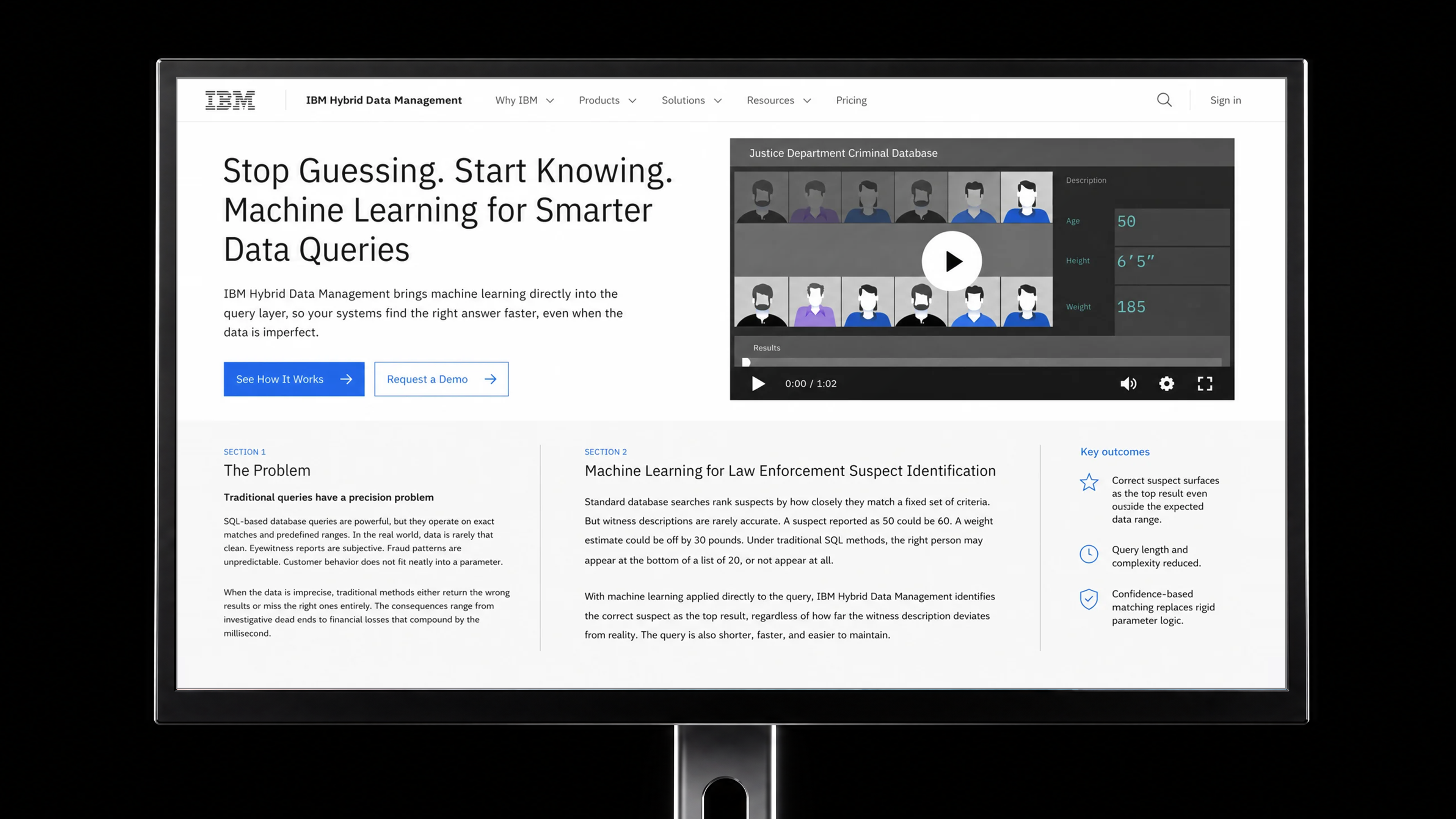
Traditional database queries rely on exact or range-based matching. When eyewitness accounts are imprecise, as they almost always are, the right suspect can be buried or missed entirely. This film shows how applying machine learning directly to the query changes that, surfacing the correct result at the top of the list, even when key data points fall outside the expected range. It also reduces the complexity of the query itself, making the process faster and less error-prone.
Translating AI into something people actually understand is harder than it looks. Most technical explainer content fails at the first step: it assumes the audience either already believes or doesn't need to. These films took the opposite approach, starting with the problem, making the old method's failure visible, and then demonstrating the improvement in direct, measurable terms.
The storytelling structure mattered. Each film follows the same logic: here is what the current system does, here is exactly where it breaks down, here is what changes when machine learning is applied. That structure mirrors how technical decision-makers actually evaluate new technology. They are not looking for inspiration. They are looking for proof.
The visual language reinforced the argument rather than decorating it. Dashboards, data points, and query results were not background elements; they were the narrative. Every frame was built around the data, which meant the content worked equally well in a sales conversation, an executive briefing, or a product demo environment.
This is work that required fluency on both sides of the table: enough creative discipline to make complex systems feel clear and human, and enough technical understanding to get the details right. That combination is what made the content credible to the audiences IBM needed to reach.